-
Representative Graphic Document 1
-
Graphic Document 1
-
Graphic Document 2
-
Graphic Document 3
-
Graphic Document 4
-
Graphic Document 5
-
Graphic Document 6
-
Vertical Panel
-
The Floating Embassy
Matthew Jones. Beijing, China
-
Name of work in English
The Floating Embassy
-
Name of work in original language
Scale as a tool to reframe, represent & reconstruct Beijing’s fragmented urban condition and society.
Prize year
Young Talent 2020
-
Work Location
Beijing, China
-
Author/s
Matthew Jones
-
School
Faculty of Architecture - KU Leuven.
Brussels, Belgium
Young Talent 2020 YT Shortlisted
The Floating Embassy
Scale as a tool to reframe, represent & reconstruct Beijing’s fragmented urban condition and society.
Program
Government & Civic
-
Labels
Embassy
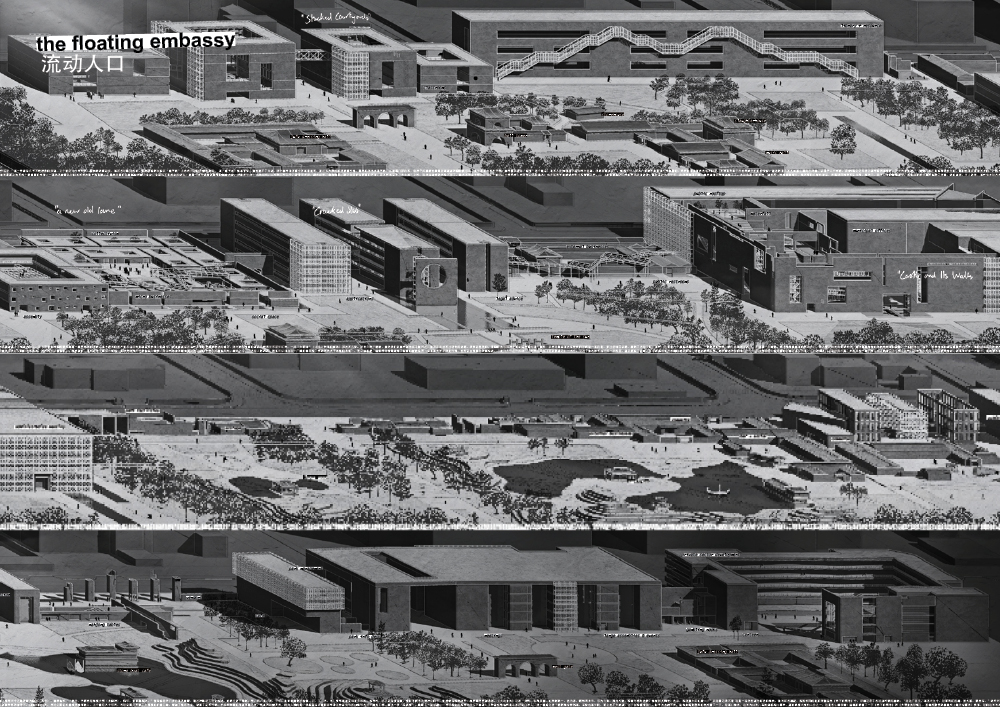
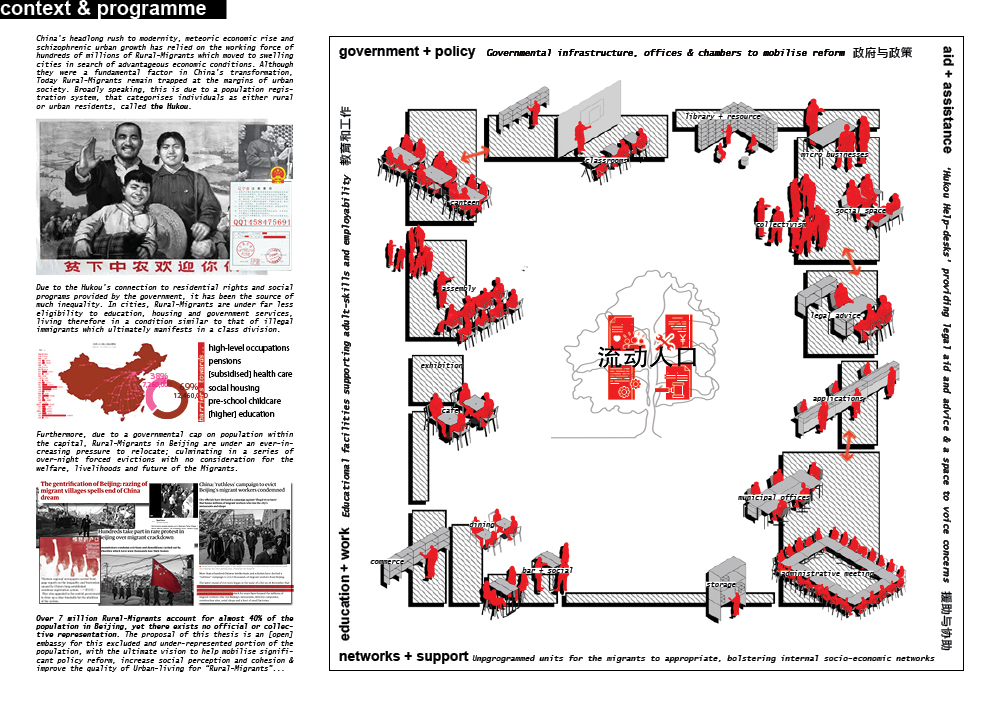
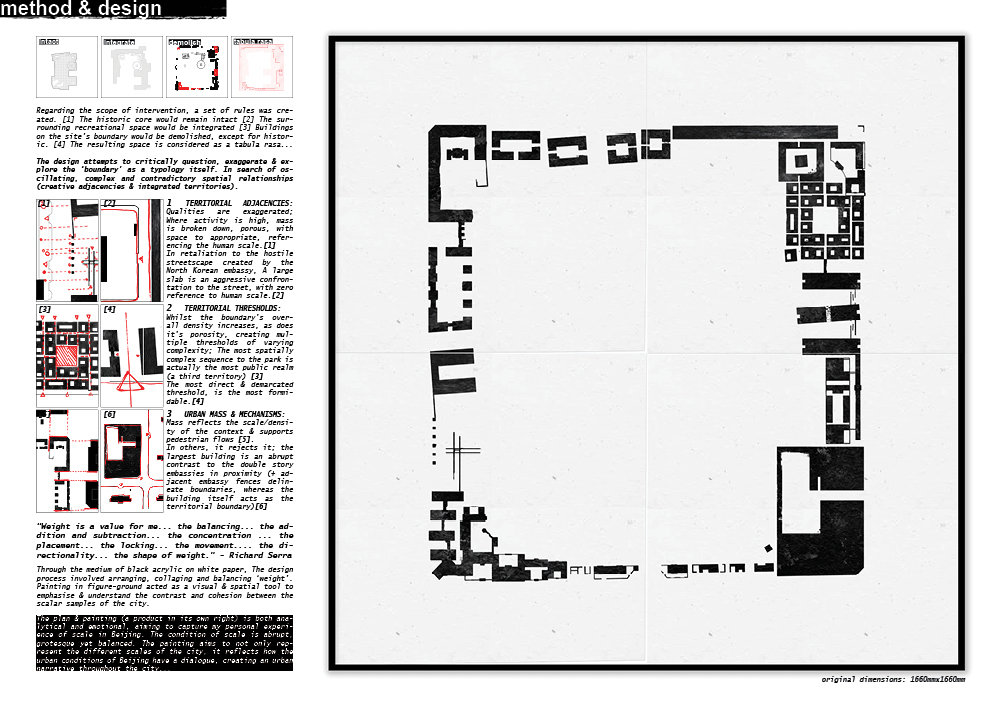
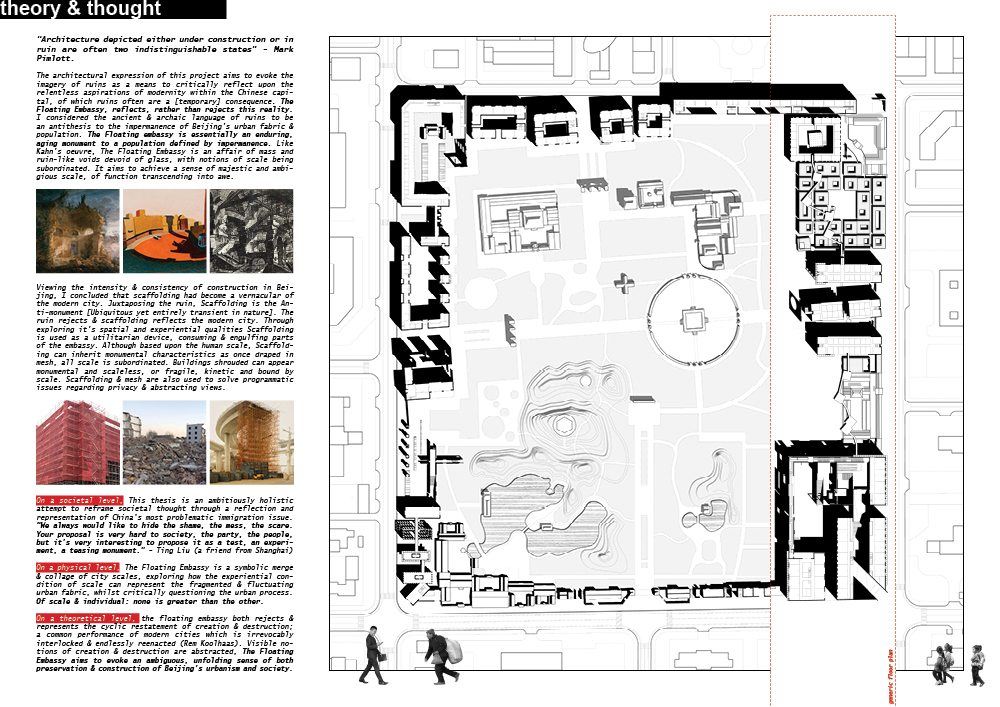
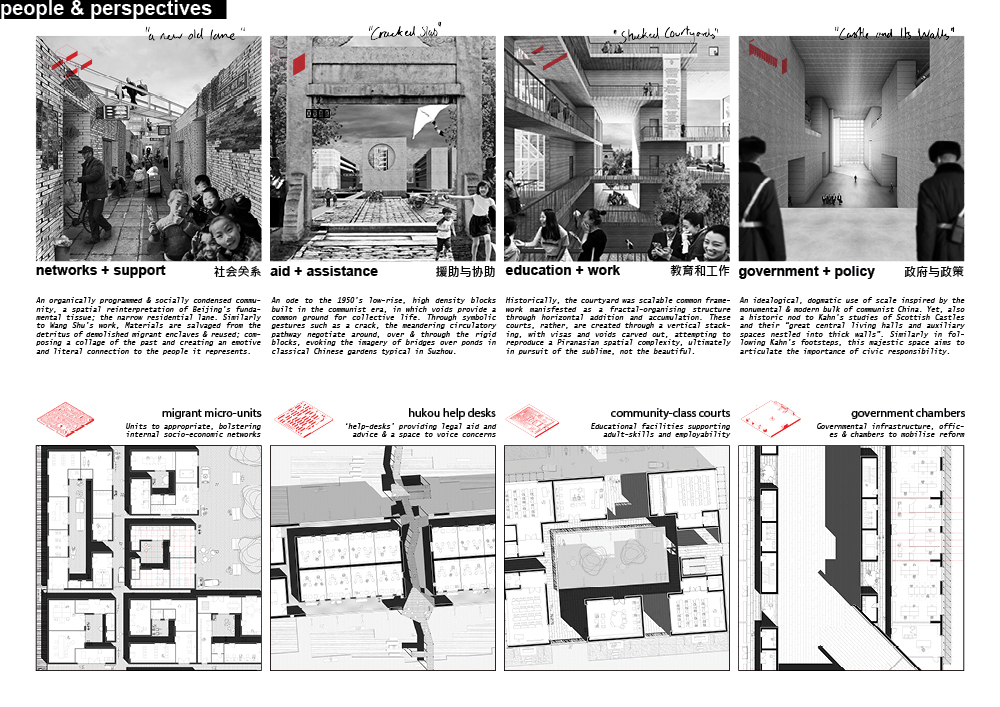
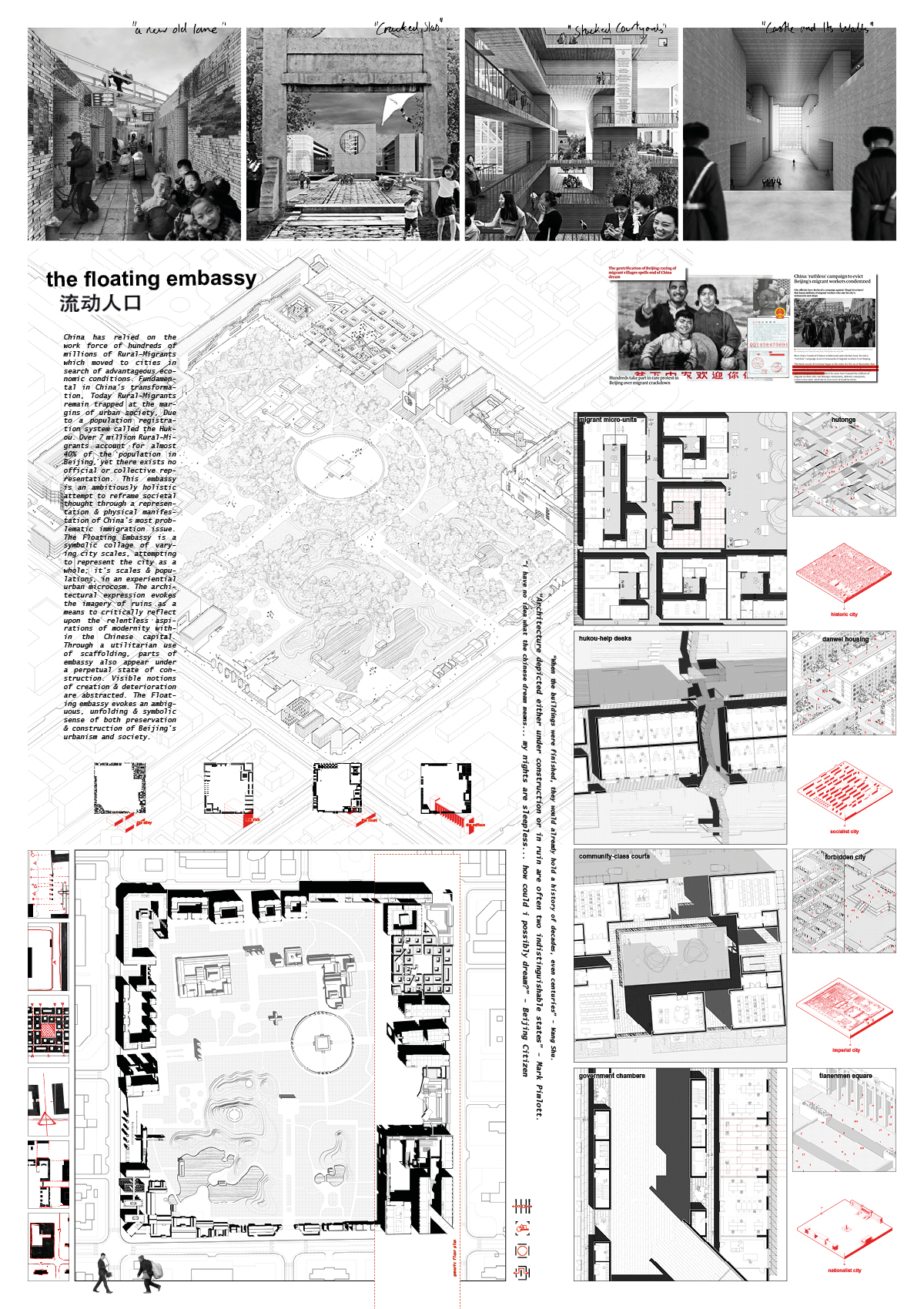
The Floating embassy collates societal, economic & governmental programmes for an excluded & under-represented population of Beijing; Rural-Migrants. Through collaging scalar-samples throughout the city, It exists as a symbolic monument to Beijing’s fragmented urban condition & population, in an experiential microcosm.
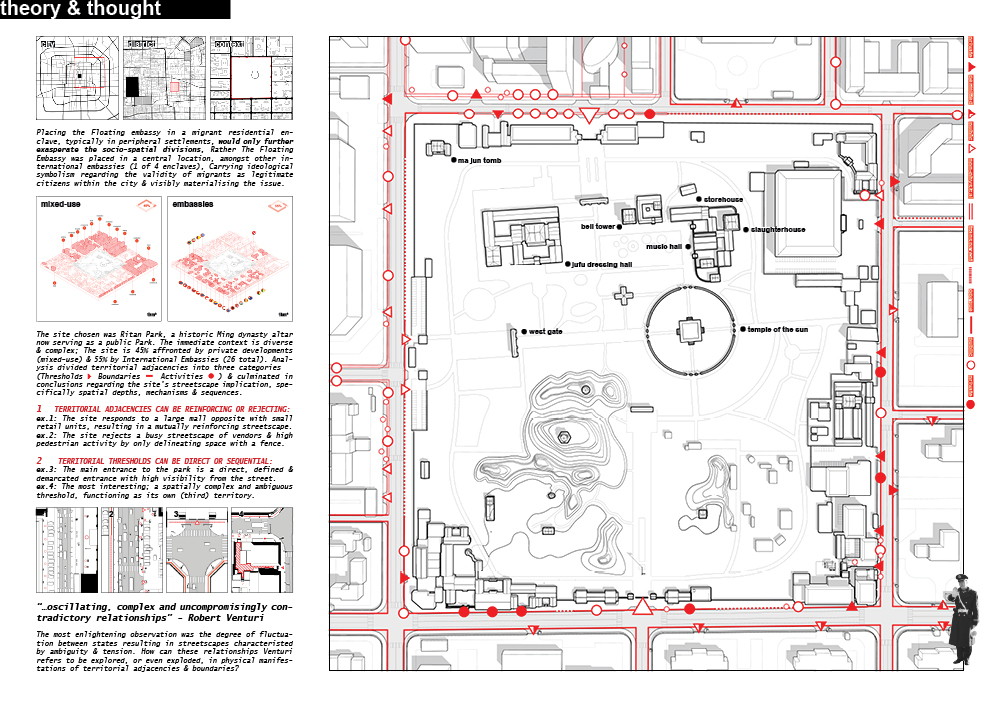
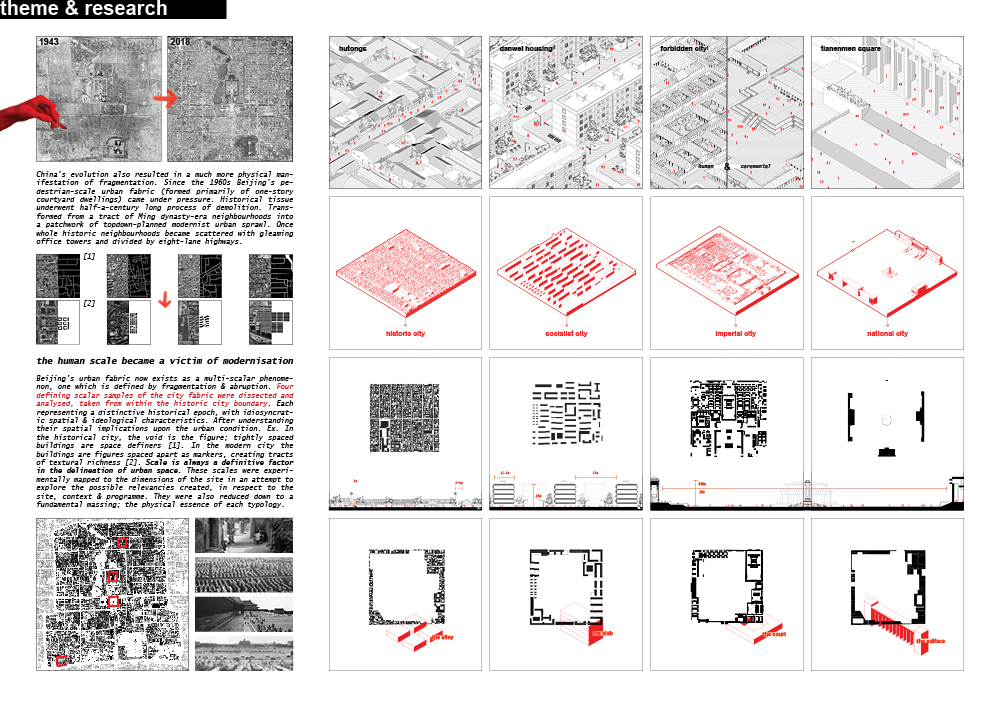
China’s headlong rush to modernity, meteoric economic rise and schizophrenic urban growth has relied on the work force of hundreds of millions of Rural-Migrants which moved to swelling cities in search of advantageous economic conditions. Although they were fundamental in China’s transformation, Today Rural-Migrants remain trapped at the margins of urban society, due to a population registration system called the Hukou. Over 7 million Rural-Migrants account for almost 40% of the population in Beijing, yet there exists no official or collective representation. The proposal is an embassy for this excluded and under-represented portion of the population. It is an ambitiously holistic attempt to re-frame societal thought through a representation & physical manifestation of China’s most problematic immigration issue. Since the 1960s Beijing’s vernacular pedestrian-scale urban tissue came under pressure. Historical residential neighbourhoods were surgically removed & grafted with tracts of generic topdown-planned urban blocks. The human scale became a victim of modernisation. Beijing’s urban fabric now exists as a multi-scalar phenomenon which is defined by fragmentation. The Floating Embassy is a symbolic collage of these varying scales, attempting to represent the city; it’s scales & populations, in an experiential urban microcosm. Following the streetscape-orientated brief, the design attempts to critically question, exaggerate & explore the territorial boundary as a typology itself. The architectural expression evokes the imagery of ruins as a means to critically reflect upon the relentless aspirations of modernity within the Chinese capital. The embassy exists as an enduring, ageing monument to a population defined by impermanence. And through a utilitarian use of scaffolding, parts of embassy also appear under a perpetual state of construction. Visible notions of creation & destruction are therefore abstracted. The Floating embassy evokes an ambiguous, unfolding & symbolic sense of both preservation & construction of Beijing’s urbanism and society.